There is something quietly powerful about Roman engineering.
No noise.
No moving parts.
No modern technology.
And yet, for centuries, water flowed exactly where it was needed.
Just beyond the famous theater of Aspendos, standing against the warm Mediterranean sky, lies one of the most impressive — and often overlooked — engineering achievements of the ancient world: the Aspendos Aqueduct.
It wasn’t built to impress.
It was built to serve.
And it did so brilliantly.
The Lifeline of a Great City
Nearly 2,000 years ago, Aspendos was one of the most important cities of Pamphylia, a prosperous Roman region along Turkey’s southern coast. Its theater hosted thousands, its markets thrived, and its citizens lived with the comfort and sophistication of a powerful empire.
But every great city has a simple, essential need:
Water.
Not just a little water — but a reliable, constant supply for fountains, baths, homes, and public spaces.
The solution was ambitious.
Roman engineers designed an aqueduct system stretching approximately 15 kilometers (9 miles), bringing fresh water from mountain springs directly into the city.
What makes Aspendos unique is not only the length of the aqueduct — but its extraordinary design.
Engineering Beyond Its Time
Unlike many aqueducts that rely solely on gravity and gentle slopes, the Aspendos Aqueduct features a remarkable innovation: an inverted siphon system.
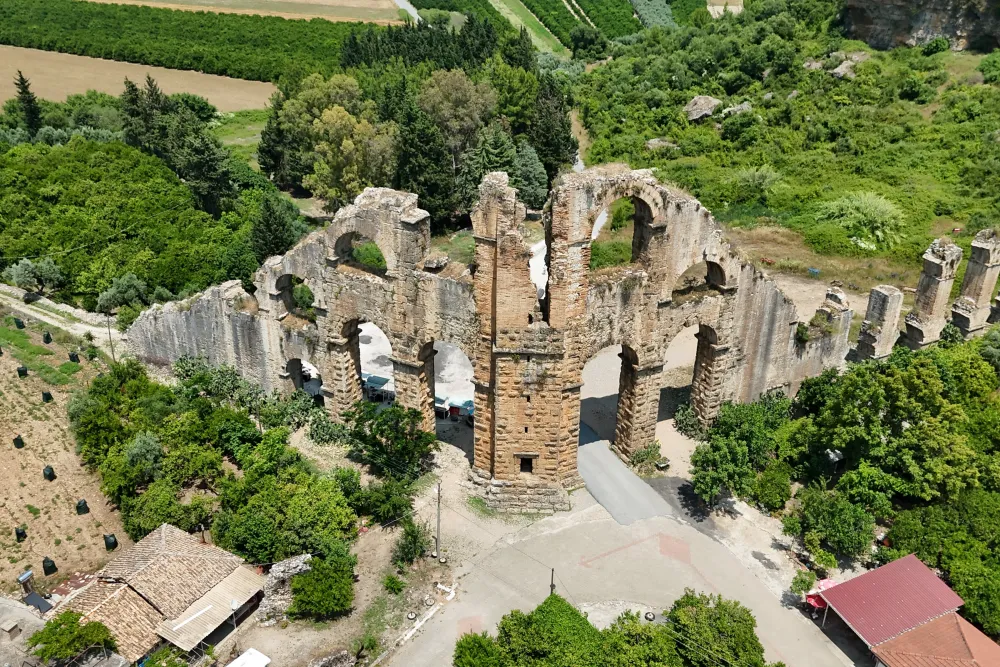
Standing at key points are tall stone towers — massive vertical structures that controlled water pressure and flow.
Water would descend into these towers, travel through pressurized stone pipes across valleys, and rise again on the other side — defying what would seem impossible without modern pumps.
Everything worked purely through physics.
No electricity.
No machines.
Just intelligence, precision, and vision.
Even today, you can see the stone pipes that once carried life into the city — carefully carved and fitted together with astonishing accuracy.
It’s a reminder that Roman engineering wasn’t just functional.
It was visionary.
Built to Last — And It Did
Centuries passed.
Empires rose and fell.
Earthquakes shook the land.
Cities were abandoned.
But parts of the Aspendos Aqueduct still stand.
Weathered, silent, and dignified.
Walking beside the remaining towers and stone channels, you begin to understand something profound: this was not temporary architecture. It was built with the expectation of permanence.
It was built for the future.
And in many ways, that future is now.
Most visitors come to Aspendos for its magnificent Roman theater — one of the best-preserved in the world.
But the aqueduct tells a deeper story.
The theater represents culture, art, and human expression.
The aqueduct represents survival, innovation, and intelligence.
One entertained the people.
The other sustained them.
Together, they reveal the full brilliance of Roman civilization.
When you stand near the aqueduct towers, there is no crowd, no stage, no performance.
Just stone.
Sky.
And silence.
Yet in that silence, you feel the presence of the engineers who stood here 2,000 years ago, calculating angles, controlling pressure, and shaping stone with mathematical precision.
They built something they would never see completed by future generations.
But they built it anyway.
And that may be the greatest legacy of all.
Located near Antalya on Turkey’s Mediterranean coast, Aspendos is easily accessible and often visited together with Perge, Side, and other ancient cities of the region.
While the theater draws the spotlight, the aqueduct offers something more intimate — a quiet encounter with the genius of ancient engineering.
It is not flashy.
It does not demand attention.
But once you see it, you realize:
Empires were not built only with armies.
They were built with water.
And with the minds that knew how to move it.