Discover the
Church of St. John in Ephesus, one of the most important early Christian sites
in Turkey, believed to be the burial place of Saint John the Apostle.
Some ruins speak through architecture, others through belief. Basilica of
Saint John carries both.
Overlooking the town of Selcuk near ancient Ephesus, the Church of St. John
stands as one of the most important early Christian sites in Turkey — a place
shaped by faith, history, and centuries of transformation.
A Sacred Place Built in Honor of Saint John
According to Christian tradition, John the Apostle spent his final years in
Ephesus and was buried on Ayasuluk Hill. In the 6th century, Byzantine Emperor
Justinian ordered the construction of a grand basilica above what was believed
to be Saint John’s tomb.
This is why the Church of St. John in Ephesus became one of the most
significant pilgrimage destinations of the Byzantine world.
A Basilica Above the Ancient World
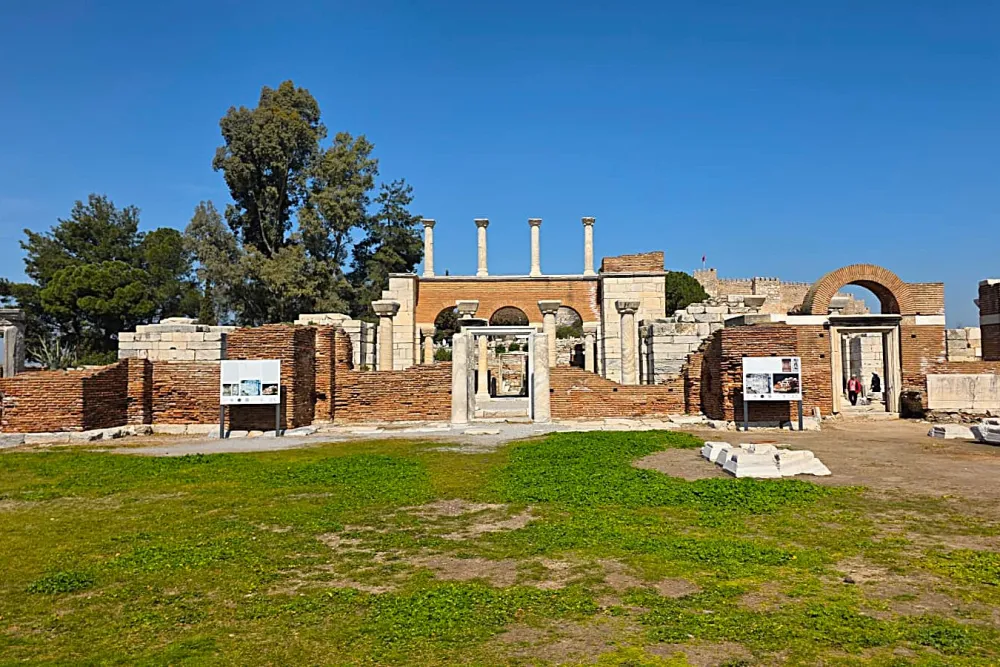
Although much of the structure survives today as ruins, the scale of the
basilica is still impressive.
Walking through the site, visitors can still
recognize: massive stone columns, arched foundations, marble fragments, traces
of Byzantine design. Even in ruins, the church continues to convey a sense of
importance and spiritual weight.
The View Over Selcuk and Ephesus
One of the most striking aspects of the site is its location.
From Ayasuluk Hill, the landscape opens toward: Selcuk
town, the plains of ancient Ephesus, distant mountains and countryside. This
elevated position gives the church a calm and reflective atmosphere.
The setting itself feels symbolic — suspended between earth, history, and
belief.
Layers of Civilizations
The Church of St. John stands in a region shaped
by many civilizations: Greek, Roman, Byzantine, Seljuk, Ottoman. Each era left
traces behind.
Nearby, visitors can also see: the remains of
ancient fortifications, Byzantine structures, traditional Anatolian
architecture. This layered environment makes Selcuk Turkey one of the
richest historical areas in the country.
A Different Kind of Ancient Site
Unlike crowded monumental ruins, the Church of St. John often feels
quieter. There is space to walk slowly to observe details. To notice the
silence between the stones. The atmosphere encourages reflection more than
spectacle.
The Connection to Early Christianity
For many visitors, the church is not simply archaeological.
It represents: early Christian history, pilgrimage
tradition, the spread of belief through Anatolia
Ephesus itself played a central role in early Christianity, and sites like
the Church of St. John continue to preserve that legacy. This makes the
basilica an essential stop for those interested in biblical sites in Turkey.
A Photographer’s Perspective
The site offers beautiful opportunities for photography.
Your photos will naturally capture: stone textures,
open sky compositions, arches and column perspectives, contrasts between ruins
and landscape
Especially focus on: wide hilltop views, architectural
symmetry, details of worn marble and stone, golden hour light across the ruins
Why the Church Still Matters
Many historical places survive because of political power or architectural
innovation.
The Church of St. John survives because of meaning. For centuries, people
traveled here seeking connection — not only to history, but to belief itself. That
emotional layer still remains visible today.
Between Ruin and Memory
The basilica no longer stands complete. Columns are broken. Walls are
incomplete. And yet, the space still feels whole in another way. Some places
lose their structure but keep their presence.
The Church of St. John is one of them.
Final Thoughts
Some ruins tell the story of empires.
The Church of St. John tells the story of faith, continuity, and
remembrance.
A quiet hill above Ephesus.
Ancient stones shaped by centuries.
And a place where history still feels deeply personal.