Discover Divrigi Great Mosque and Hospital, a UNESCO World Heritage Site in
Sivas famous for its extraordinary stone carvings and medieval architecture.
Some of Anatolia's greatest masterpieces were not built in its largest
cities.
Far from Turkey's familiar tourist routes, in the historic town of Divrigi
in Sivas Province, stands a building that has fascinated visitors for nearly
800 years.
At first glance, its exterior appears surprisingly modest.
But look closer, and the stone begins to tell an extraordinary story.
Welcome to Divrigi Great Mosque and Hospital (Divrigi Ulu Camii ve Darussifasi),
one of the most remarkable architectural treasures of medieval Anatolia.
An 800-Year-Old Architectural Masterpiece
Built in 1228–1229 during the Mengucekid period, the complex was
commissioned by Ahmed Shah and his wife, Turan Melek.
While Ahmed Shah commissioned the mosque, Turan Melek founded the adjoining
hospital, known as the Darussifa.
Together, these buildings represent an extraordinary combination of
religious architecture, healthcare and artistic craftsmanship.
In 1985, the complex was inscribed on the UNESCO World Heritage List,
recognizing its exceptional cultural and architectural importance.
When Stone Becomes Art
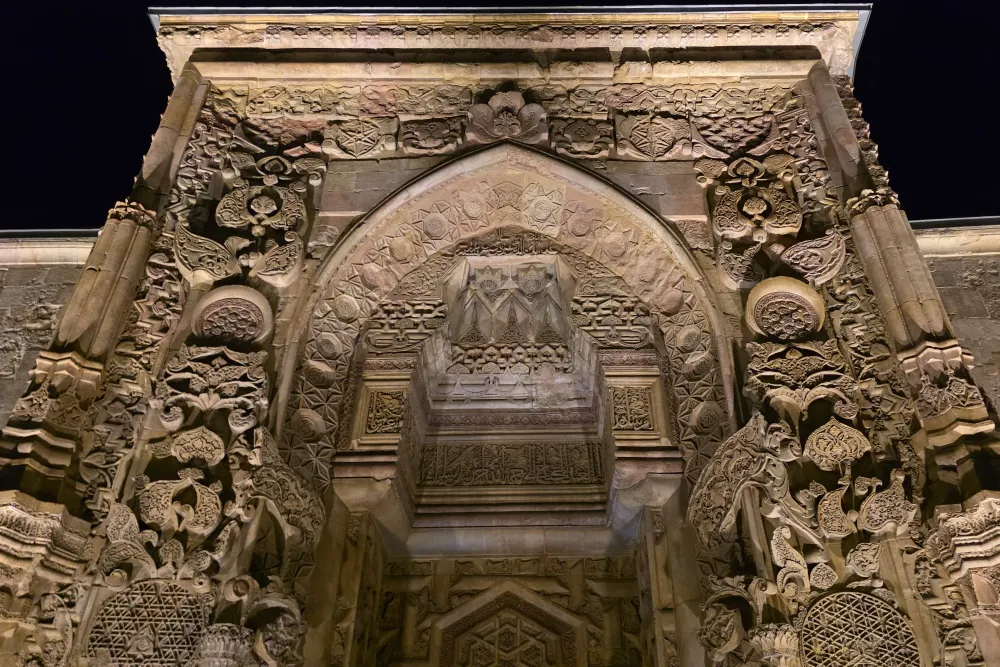
Perhaps the most unforgettable features of Divrigi Great Mosque are its
monumental stone entrances.
Unlike the relatively plain exterior walls, the portals are covered with
elaborate carvings.
Geometric patterns, floral motifs and deeply sculpted decorations create an
almost lace-like appearance.
What makes them particularly fascinating is that each entrance has its own
distinctive design.
The remarkable craftsmanship demonstrates how medieval Anatolian artisans
transformed ordinary stone into something extraordinary.
Bee Travel Tip: Don't rush
through the entrances. Spend time examining the details of each portal. The
closer you look, the more you begin to appreciate the craftsmanship.
A Place of Worship and Healing
Divrigi is more than a beautiful mosque.
Beside it stands the Darussifa, a medieval hospital that reflects the
importance placed on healing and community welfare.
Its architectural design includes a central hall, surrounding rooms and a
water feature.
Imagine this space centuries ago, when the sound of flowing water
accompanied the daily activities of a place dedicated to care.
The combination of worship and healing makes Divrigi especially meaningful.
It reminds us that architecture can serve not only spiritual needs but also
the well-being of society.
Why Is Divrigi So Special?
Turkey is home to extraordinary mosques, palaces and ancient monuments.
Yet Divriği stands apart.
Its stone decorations are unusually intricate, its architectural details
are distinctive, and its location takes travelers far beyond the country's most
familiar sightseeing routes.
The complex reopened in May 2024 following an extensive restoration,
allowing visitors to appreciate this remarkable heritage once again.
Bee Travel Insight: Divrigi
is a reminder that Anatolia's cultural heritage isn't concentrated in major
cities. Some of its finest artistic achievements are found in smaller towns,
where their historical importance can be surprisingly easy to overlook.
Is Divrigi Great Mosque Worth Visiting?
For travelers interested in architecture, history, Islamic art or UNESCO
heritage, absolutely.
However, Divrigi is not a convenient addition to every classic Turkey
itinerary.
Its location makes it better suited to a longer journey through Central or
Eastern Anatolia.
Bee Travel Recommendation:Consider Divrigi as part of a thoughtfully planned cultural road trip. Check
current visitor access before traveling, particularly if seeing the interior is
important to you.
Beyond the Classics
Divrigi Great Mosque proves that extraordinary architecture doesn't need an
extraordinary location to make an impression.
Sometimes the most remarkable discoveries are waiting in quiet Anatolian
towns, far from the crowds.
At Bee Travel Turkey, we believe exploring Turkey means discovering these
overlooked stories alongside its famous landmarks.
Because sometimes, the greatest masterpieces are the ones you never expected to find.