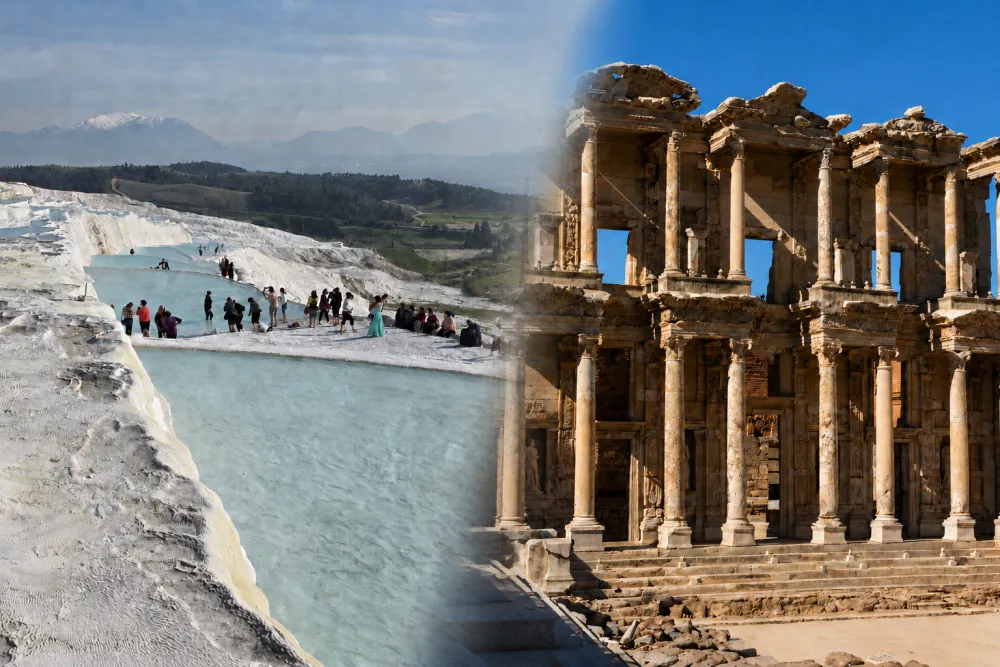
Ephesus or Pamukkale? Compare history, scenery, travel time, and
experiences to decide which destination deserves a place in your Turkey
itinerary when time is limited.
Turkey has an unusual problem for travelers:
There are simply too many extraordinary places to visit.
This becomes particularly obvious when planning a journey through western
Turkey.
Two destinations appear again and again on first-time Turkey itineraries:
Ephesus and Pamukkale.
Ephesus offers one of the most impressive ancient city experiences in the
country, with monumental streets, temples, theatres, and the iconic Library of
Celsus.
Pamukkale combines something completely different—the brilliant white
travertine terraces with the ancient city of Hierapolis sitting directly above
them.
Ideally, we'd recommend experiencing both.
But what if you don't have enough time?
If you have to choose between Ephesus or Pamukkale, the answer
depends largely on what you want to experience.
And unlike some travel comparisons, there are situations where we would
clearly recommend one over the other.
Let's take a closer look.
Ephesus: Walking Through an Ancient City
Ephesus isn't simply a collection of ruins.
It's a place where the structure of an ancient city is still remarkably
easy to imagine.
As you walk through the archaeological site, you follow streets that were
once used by thousands of people living in one of the most important cities of
the ancient world.
You'll encounter monuments such as the Library of Celsus, Great Theatre,
Temple of Hadrian, Curetes Street, and numerous other remains.
For travelers fascinated by history, the experience is powerful because the
individual monuments connect together.
You aren't looking at one isolated temple.
You're walking through a city.
Pamukkale: Where Nature Meets History
Pamukkale creates a completely different first impression.
Its famous white terraces were formed by mineral-rich thermal waters
flowing across the hillside over thousands of years.
The result is one of Turkey's most recognizable natural landscapes.
But Pamukkale isn't only about the travertines.
Immediately above them lies Hierapolis, an ancient city with a
remarkable theatre, extensive necropolis, baths, religious structures, and
other archaeological remains.
This means Pamukkale gives you two experiences in one destination:
A natural wonder and an ancient city.
That's what makes the comparison with Ephesus so interesting.
Bee Travel Tip
If you're choosing between Ephesus and Pamukkale, don't make the decision
based only on which photographs look more impressive. Ask yourself whether you
want your day to focus primarily on ancient history or whether you'd
prefer a combination of archaeology and unusual natural scenery.
Which Is Better for History Lovers?
Here, our recommendation is relatively straightforward.
Ephesus.
If ancient history is one of the main reasons you're visiting Turkey and
you can only choose one of these destinations, we would generally prioritize
Ephesus.
The scale and structure of the archaeological site make it easier to
understand how an ancient city actually functioned.
Walking down Curetes Street toward the Library of Celsus creates a sense of
connection between the monuments that isolated archaeological remains sometimes
cannot provide.
Hierapolis is historically important too, and its theatre and necropolis
are particularly impressive.
But if the question is purely:
"Which provides the stronger ancient city experience?"
For most first-time visitors, our answer would be Ephesus.
Which Has the More Unique Landscape?
Now the advantage shifts.
Pamukkale.
Ephesus is extraordinary because of what humans created there.
Pamukkale combines human history with a geological landscape.
The contrast between white travertines, thermal water, ancient ruins, and
the surrounding countryside gives the destination a visual identity completely
different from Ephesus.
For travelers who have already visited major ancient sites elsewhere in the
Mediterranean but want something visually different, Pamukkale may therefore be
the more surprising choice.
Bee Travel Insight
One mistake travelers sometimes make is treating Ephesus and Pamukkale as
interchangeable historical attractions.
They're not.
Although both include major archaeological sites, the experiences are
fundamentally different.
Ephesus is primarily an ancient-city experience.
Pamukkale is a nature-and-history experience.
Understanding that distinction makes choosing between them much easier.
How Much Time Do You Need for Ephesus?
Ephesus itself can be explored within a substantial sightseeing day,
depending on your pace and how deeply you want to explore the site.
But the surrounding area offers more than Ephesus alone.
Travelers interested in history and religion may also want to visit nearby
places connected to the broader historical landscape.
This means the region can easily justify more time if history is one of
your major interests.
A knowledgeable guide can also make a significant difference at Ephesus.
Ancient ruins become much more meaningful when you understand what the
buildings were used for, who lived there, and how daily life functioned.
Without that context, it's easy to walk past important details without
realizing their significance.
How Much Time Do You Need for Pamukkale?
Pamukkale and Hierapolis can also form the core of one sightseeing day.
Because the travertines and archaeological site are directly connected, you
can experience both without traveling between separate attractions.
This makes Pamukkale relatively compact from a sightseeing perspective.
However, transportation to and from Pamukkale still needs to be considered.
Adding the destination simply because the sightseeing itself fits into one
day can be misleading if reaching it requires substantial additional travel.
This is where your overall route becomes more important than the
attraction alone.
Don't Ignore Geography
This may actually determine your decision.
If you're already staying around Kusadasi, Selcuk, or Izmir, Ephesus
fits naturally into the itinerary.
Adding Pamukkale requires continuing farther inland.
That's completely reasonable if Pamukkale is part of a wider route, but
less attractive if you need to make a long detour only to return immediately
afterward.
Likewise, if your journey already takes you through Denizli or you're
continuing toward another region where Pamukkale fits naturally, visiting it
may make excellent sense.
The question shouldn't only be:
"Which place do I want to see?"
It should also be:
"What does visiting this place do to the rest of my itinerary?"
What If You're Already Visiting Other Ancient Cities?
This is another useful way to decide.
Suppose your Turkey itinerary already contains several major archaeological
destinations.
You may decide that Pamukkale adds greater variety because the travertines
provide a completely different visual experience alongside Hierapolis.
On the other hand, if Ephesus would be your primary opportunity to explore
a major ancient city in Turkey, we'd be much more hesitant to remove it.
A good itinerary isn't about collecting similar attractions.
It's about creating variety without sacrificing the experiences that
matter most to you.
Bee Travel Recommendation
If this is your first trip to Turkey, ancient history interests you,
and you genuinely only have time for one, we would generally choose Ephesus.
Choose Pamukkale instead if the white travertines are a personal
bucket-list experience, you want a stronger combination of nature and
archaeology, or Pamukkale fits significantly better into your overall route.
Choose Ephesus If...
Ephesus is probably the better choice if you:
-Love ancient history.
-Want to experience one of Turkey's great archaeological sites.
-Are already staying around Izmir, Selcuk, or Kusadasi.
-Want to see the Library of Celsus.
-Enjoy guided historical sightseeing.
-Are interested in Roman urban life.
-Have limited time and want to prioritize historical depth.
For many first-time visitors interested in Turkey's ancient civilizations,
Ephesus is difficult to replace.
Choose Pamukkale If...
Pamukkale may be the better choice if you:
-Want a combination of nature and history.
-Have the travertines on your personal bucket list.
-Enjoy unusual landscapes and photography.
-Are interested in thermal history.
-Want to explore Hierapolis.
-Already have substantial ancient-history sightseeing elsewhere in your
itinerary.
-Can include Pamukkale naturally without creating an inefficient detour.
In these circumstances, Pamukkale can add wonderful variety to your
journey.
What If You Can Visit Both?
If your itinerary allows it without rushing, Ephesus and Pamukkale work
very well together precisely because they're different.
You might experience the depth of ancient urban life at Ephesus and then
encounter the unusual combination of archaeology and nature at Pamukkale.
The important part is allowing enough time.
Adding both destinations but constantly watching the clock defeats the
purpose.
Sometimes an additional night transforms an exhausting route into an
enjoyable one.
And sometimes removing one destination is the better decision.
Don't Choose by Checklist
There's a temptation when planning a first trip to Turkey to create a list:
Istanbul. ✓
Cappadocia. ✓
Ephesus. ✓
Pamukkale. ✓
But travel doesn't work particularly well as a checklist.
The goal isn't to return home having technically stood inside the greatest
possible number of famous places. The goal is to have enough time to experience
the places you choose.
That's particularly important when traveling long distances across Turkey.
Every additional destination means another transfer, another hotel change,
and additional travel time. Sometimes less really does become more.
Choose the Right Route with Bee Travel Turkey
At Bee Travel Turkey, we don't believe every itinerary needs to
include every famous destination.
Sometimes adding another stop improves a journey.
Sometimes it makes the journey unnecessarily exhausting.
That's why we look at your available time, interests, travel pace, hotel
locations, domestic flights, and private transportation before recommending a
route.
If Ephesus belongs in your journey, we'll explain why.
If Pamukkale makes more sense, we'll tell you that too.
And if your schedule allows both without rushing, we'll design the route so
they complement each other naturally.
Because a personalized Turkey itinerary shouldn't be built from a
checklist.
It should be built around you.
Aegean or Mediterranean Coast: Which Is Better for Your Turkey Trip?
Cappadocia or Pamukkale: Which Should You Visit?