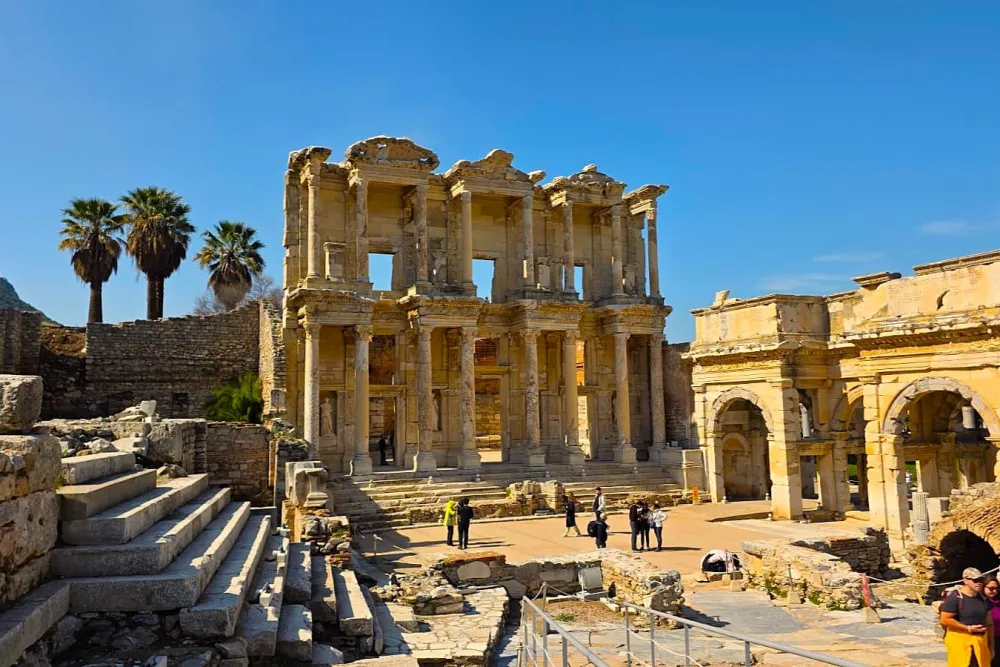
Discover the Library of Celsus in Ephesus, one of the most iconic Roman
structures in Turkey, famous for its architecture, history, and timeless
beauty.
Some ruins feel distant from the world they once belonged to, others still
seem alive.
Library of Celsus belongs to the second.
Standing at the heart of Ephesus, its elegant facade continues to draw
people from around the world — not only because of its history, but because of
its presence.
A Library Built for Memory
The Library of Celsus was constructed in the 2nd century AD in honor of the
Roman senator Tiberius Julius Celsus Polemaeanus.
It served two purposes: as a monumental library, and
as a mausoleum for Celsus himself. This combination made it highly unusual in
Roman architecture. At its height, the library is believed to have housed
around 12,000 scrolls, making it one of the most important libraries of the
ancient world.
The Facade That Defines Ephesus
Even people who know little about ancient history often recognize the
Library of Celsus instantly.
Its facade is one of the most iconic images of
Turkey: tall Corinthian columns, layered symmetry, intricate carvings, carefully
balanced proportions.
This is why the Library of Celsus in Ephesus remains one of the most
photographed ancient structures in the country.
Architecture Designed to Impress
The Romans understood visual impact and the Library of Celsus was designed
with that in mind.
The structure uses architectural techniques that
subtly change perception: columns placed at varying distances, elevated central
sections, curved visual flow. These details create an illusion of greater size
and depth. Even today, the building feels remarkably elegant.
A Place of Knowledge and Prestige
In the Roman world, libraries represented more than books.
They symbolized: education, cultural
sophistication, political influence.
For Ephesus, the library reflected the city’s
importance as: a center of trade, a major Roman city, an intellectual hub of
the Mediterranean world. The Library of Celsus became a statement of prestige
as much as knowledge.
Walking Through Ancient Ephesus
The library stands at the end of Curetes Street, one of the main roads of
ancient Ephesus. As visitors walk down the marble street today, the façade
slowly appears ahead and even after centuries, it still creates a sense of
arrival. Few ancient sites reveal themselves so dramatically.
Light and Atmosphere
The experience of the library changes throughout the day. Morning light
reveals texture in the stone. Afternoon shadows create depth between the
columns. At golden hour, the facade seems almost warm in color — as if the
stone itself remembers sunlight. This atmosphere is part of what makes Ephesus
ancient city unforgettable.
A Photographer’s Perspective
Your photos will naturally work beautifully here.
The Library of Celsus offers: perfect symmetry, dramatic
architectural lines, layered depth, rich light and shadow contrast.
Especially focus on: frontal symmetry shots, columns
and carved details, perspective views from Curetes Street, golden hour lighting.
More Than a Ruin
The Library of Celsus survives because it represents something timeless. Not
only architecture, not only history but the human desire to preserve knowledge,
memory, and identity. Even in ruins, that purpose still feels visible.
Why the Library Still Fascinates People
Thousands of years later, people continue to stand
silently in front of it. Perhaps because libraries represent something
universal: curiosity, learning, continuity and in Ephesus, those ideas were
carved directly into stone.
Final Thoughts
Some monuments survive because they were powerful. The Library of Celsus survives because it was meaningful. Elegant without excess. Grand without heaviness. And even now, it remains one of the most unforgettable places in the ancient world.