Discover Myra Ancient City in Turkey, famous for its Lycian rock tombs,
Roman theater, and connection to Saint Nicholas.
Some ancient cities impress with monuments, others with mystery. Myra
somehow carries both.
Hidden along Turkey’s Mediterranean coast, Myra
combines: dramatic rock-cut tombs, Roman architecture, traces of forgotten
civilizations and stories that still echo through history.
A City of the Lycian Civilization
Myra was once one of the most important cities of
the ancient Lycian civilization. Located near present-day Demre in southern
Turkey, the city became a major center of: trade, religion, politics. Its
strategic location connected inland Anatolia with the Mediterranean world.
This is why Myra Ancient City Turkey remains one of the most
fascinating archaeological sites on the Turkish coast.
The Rock Tombs of Myra
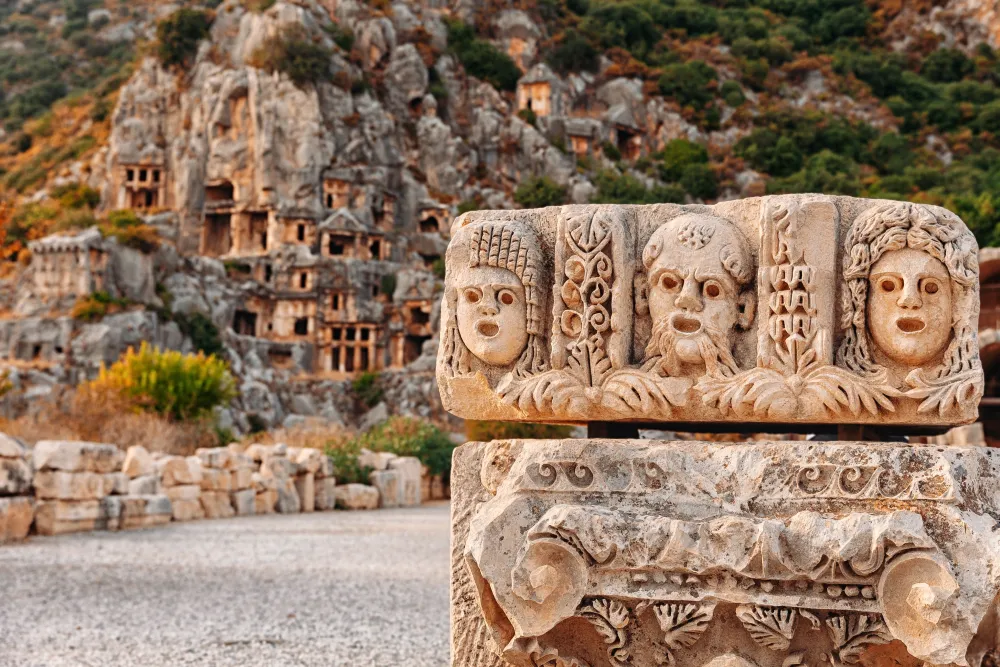
The most iconic feature of Myra is impossible to miss. Carved directly into
steep cliffs above the city are extraordinary Lycian rock tombs. These tombs
were designed to resemble houses and temples, reflecting the Lycian belief that
the dead would continue their journey in another world. From a distance, the
cliffs almost appear architectural rather than natural. The rock tombs of
Myra are considered some of the finest examples of Lycian funerary
architecture.
A Theater That Still Holds Presence
Below the cliffs stands the large Roman theater of Myra. Even after
centuries of earthquakes and change, much of the structure remains remarkably
preserved.
Walking through the theater, you notice: stone
seating rising in layers, carved masks and decorative details, the acoustics of
the open space. It still feels capable of gathering people together.
Layers of Civilization
Like many ancient cities in Anatolia, Myra changed over time.
It passed through: Lycian influence, Roman rule, Byzantine
Christianity. Each era left traces behind.
This layered history gives Myra archaeological site a unique
atmosphere.
The Connection to Saint Nicholas
Myra is also closely connected to Saint Nicholas, who served as
bishop of the city during the Byzantine period. Over time, stories surrounding
Saint Nicholas spread across Europe and eventually inspired the figure now
known as Santa Claus. This unexpected connection gives Myra an additional
cultural and historical significance far beyond Turkey.
A Landscape Shaped by Stone
The environment surrounding Myra feels dramatic but calm. Mountains rise
behind the ruins. Mediterranean light reflects across pale stone surfaces.
The contrast between: cliffs, carved tombs, open
sky creates a landscape that feels almost cinematic.
A Photographer’s Perspective
Your photos will naturally work beautifully here.
Myra offers: dramatic vertical compositions, texture-rich
stone surfaces, layered historical elements, strong Mediterranean light.
Especially focus on: rock tomb perspectives, theater
symmetry, wide-angle cliff compositions, shadow and texture details.
More Than a Historical Site
What makes Myra memorable is not only what survives physically.
It’s the feeling that people once lived intensely
here: worshipped, traded, gathered, buried their dead in monumental ways. The
city still carries traces of that energy.
Why Myra Still Fascinates Travelers
Some ancient sites feel distant from modern life. Myra feels surprisingly
human. Its tombs are emotional, its theater feels alive, its history connects
civilizations across centuries.
This combination makes Myra Ancient City one of the most captivating
places in Turkey.
Final Thoughts
Some ruins remain because they were powerful. Myra remains because it was meaningful. A city carved into cliffs, shaped by belief, and preserved by time. And even today, it continues to stand quietly between history and legend.