You walk along an ancient stone road, just outside modern-day Bergama.
The air is quiet.
Not empty—just calm.
This path does not lead to an ordinary archaeological site.
It leads to one of the most important healing centers of the ancient world: Pergamon Asclepion.
Here, more than 2,000 years ago, people came not only to cure their bodies, but also to heal their minds and souls.
And here, the symbol of modern medicine—the serpent—found its meaning.
For the ancient world, illness was never just physical.
Pain had a spiritual and emotional side, and true healing required balance.
The Asclepion of Pergamon was dedicated to Asclepius, the divine physician of Greek mythology.
According to legend, Asclepius was such a skilled healer that he could even bring the dead back to life.
This power alarmed Zeus, who struck him down—but humanity never forgot him.
Instead, his name became eternal.
Temples, hospitals, and healing sanctuaries across the ancient world were built in his honor.
Pergamon’s Asclepion became one of the most respected among them.
Look at hospitals, ambulances, or pharmacies today and you will see it:
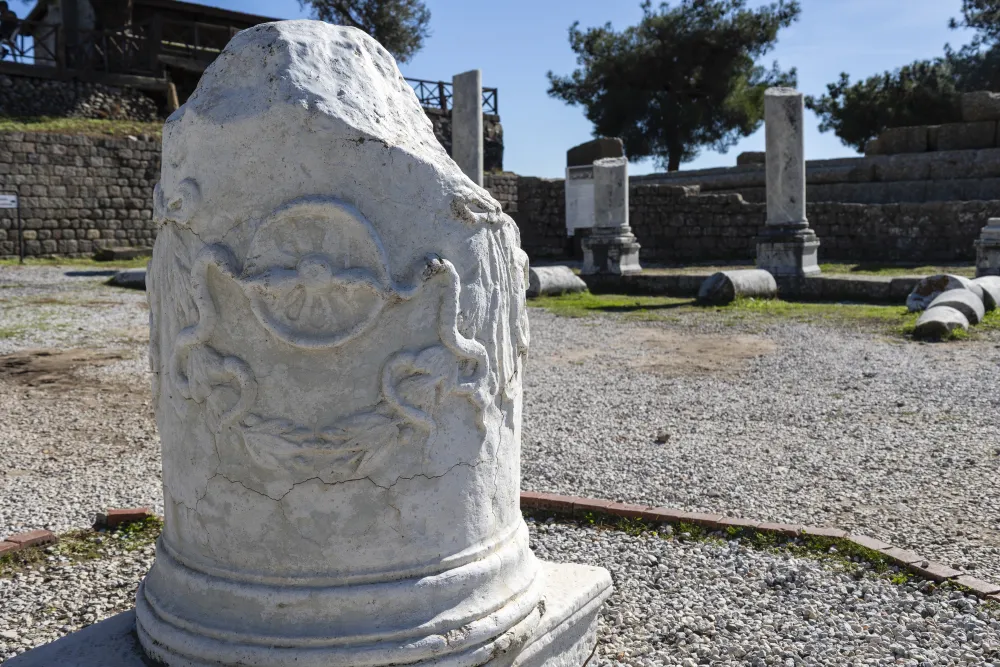
a serpent entwined around a staff.
This symbol was not chosen by chance.
In ancient healing sanctuaries, serpents were sacred animals.
They represented:
Renewal, because they shed their skin
Wisdom, because they move silently and observe
Healing, because their venom could be both poison and medicine, depending on the dose
At the Pergamon Asclepion, patients took part in a ritual called incubation.
They slept inside the sacred area, believing that Asclepius would appear in their dreams—often in the form of a serpent—to reveal the path to healing.
To see a serpent in one’s dream was considered a powerful sign of recovery.
And so, the serpent became the eternal emblem of medicine.
What makes the Pergamon Asclepion extraordinary is how advanced its approach was.
Healing here was holistic:
Herbal remedies and natural medicines
Mud baths and thermal water therapy
Diet, rest, and physical movement
Music, theater, and storytelling
Dream interpretation and psychological guidance
This was not only a medical center—it was an early form of psychotherapy.
One of history’s most influential physicians, Galen, was trained here before carrying this knowledge to Rome, shaping medical practice for centuries.
In many ways, modern medicine began in Pergamon.
As you walk through the ruins today, something becomes clear.
This place is quiet, but it is not silent.
The stones seem to whisper a simple truth:
Human beings have always searched for healing.
Across centuries, cultures, and civilizations, the desire to feel whole again has never changed.
That is why the serpent still represents medicine.
That is why the staff still stands.
And that is why the Asclepion of Pergamon still matters.
When you visit the Asclepion, you are not just seeing ancient ruins.
You are stepping into the story of humanity’s earliest understanding of health, balance, and hope.
If your journey through Turkey includes Bergama,
do not miss this place.
Because some stories are not only told—
they are felt.