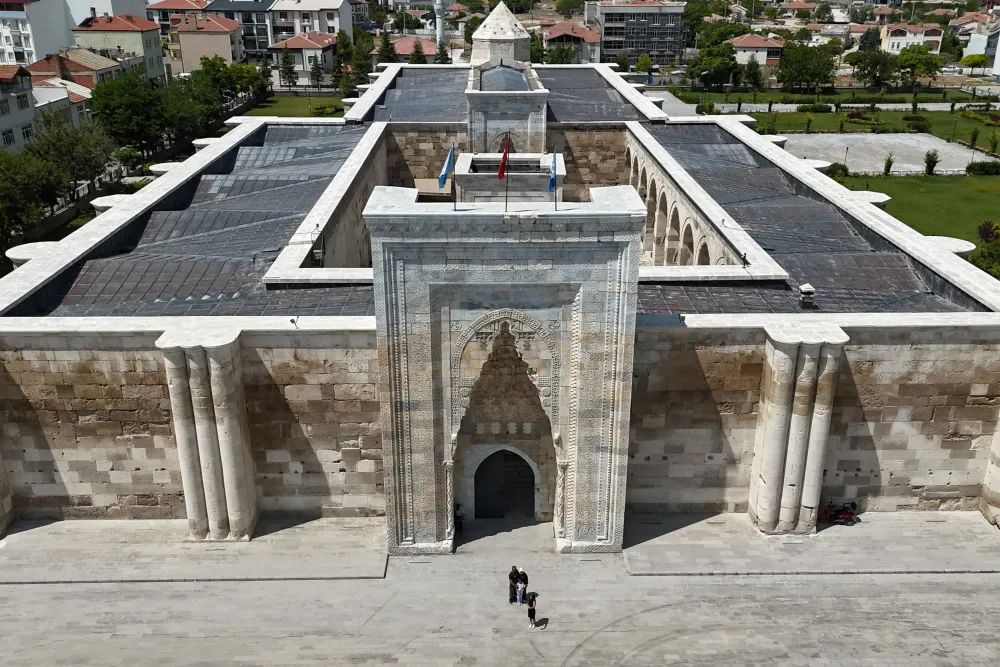
In the middle of the Anatolian steppe, where the land stretches endlessly beneath the sky, Sultan Hanı Caravanserai rises with quiet authority. Long before modern highways and fast travel, this was a place where the road itself paused to breathe. As you approach its monumental stone walls, time seems to slow—almost respectfully—as if the centuries still expect arriving travelers.
Built in the 13th century during the height of the Seljuk Empire, Sultan Hanı was not merely a roadside stop. It was a sanctuary. Merchants arriving from the Silk Road carried more than silk and spices; they brought stories from Persia, Central Asia, the Mediterranean, and beyond. Here, those stories were exchanged over shared meals, warm fires, and the comforting certainty of thick stone walls protecting all who entered.
Passing through the richly carved monumental portal feels like crossing a threshold between worlds. Outside lies the vast openness of Anatolia; inside, a carefully ordered universe unfolds. The wide courtyard once echoed with the sounds of camels settling for the night, blacksmiths repairing horseshoes, and travelers washing away the dust of the road. Every corner had a purpose, every space designed to serve both body and spirit.
When winter arrived, life moved into the covered hall—an architectural marvel supported by massive stone piers. In the dim light filtering through small openings above, travelers slept side by side, strangers bound together by the simple truth of being far from home. Rank, language, and origin mattered little here. Under this roof, everyone was equal before the journey ahead.
Sultan Hanı was more than shelter; it was a promise. A promise that no traveler would be left alone on the road, that trade could flourish through trust, and that hospitality was not a luxury but a duty. The Seljuks understood that strong roads built strong civilizations—and caravanserais like this were their beating heart.
Today, standing silently beneath its towering walls, Sultan Hanı still tells its story. Not loudly, not insistently—but patiently, to those willing to listen. It reminds us that travel has always been about more than reaching a destination. It is about the pauses in between, the places where paths cross, and the shared human experience of being on the road.
And as the wind sweeps across the plain once more, it carries with it an old truth: some journeys never truly end—they simply wait to be remembered.