Discover the Temple of Hadrian in Ephesus, one of the most
beautiful Roman structures in Turkey, known for its architecture and historical
significance.
Some ancient
structures impress with size, others with detail. Temple of Hadrian belongs to
the second. Standing along the famous Curetes Street of Ephesus, this elegant
monument captures something unique about Roman architecture: Refinement.
A Monument Built
for an Emperor
The Temple of
Hadrian was constructed in the 2nd century AD in honor of the Roman Emperor
Hadrian, one of the most influential rulers of the Roman Empire. Unlike massive
temples designed to dominate the skyline, this structure feels more intimate
and artistic. Its purpose was not only ceremonial — it was symbolic. It
reflected the connection between Ephesus and imperial Rome.
The Beauty of
Architectural Detail
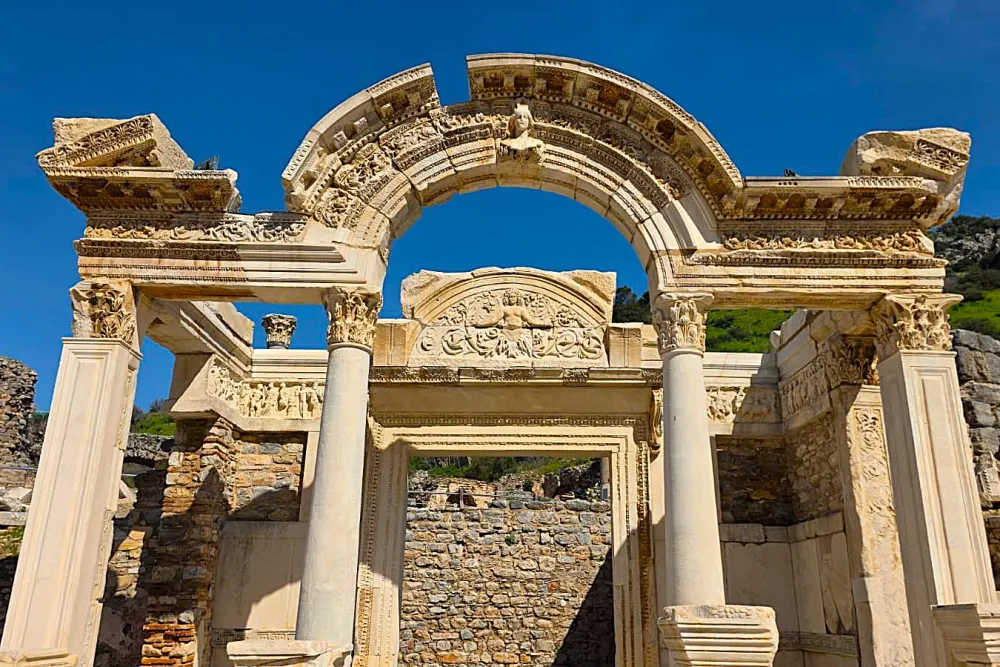
At first glance,
the Temple of Hadrian may seem small compared to other ruins in Ephesus.
But the closer you look, the more impressive it becomes. You begin to
notice: Delicate carvings, decorative Corinthian columns, symmetrical
proportions, elegant arches.
This is why the Temple
of Hadrian in Ephesus is considered one of the most photogenic structures
in the ancient city.
The Arch That
Defines the Temple
One of the most
recognizable elements is the curved central arch above the entrance. This
feature gives the temple a softer and more refined appearance compared to
heavier Roman monuments.
Inside the arch,
visitors can still see decorative reliefs and traces of artistic detail that
survived centuries of earthquakes, weather, and time.
These details
reveal the sophistication of Roman architecture in Turkey.
Walking Along
Curetes Street
The temple stands
directly on Curetes Street, one of the main roads of ancient Ephesus.
As people walked this street nearly two thousand years ago, they would have
passed: Fountains, statues, public buildings, temples like this one. Today, the
same stones still guide visitors through the city. This creates a rare feeling
of continuity between past and present.
More Than Just a
Ruin
What makes the
Temple of Hadrian special is not only its architecture. It’s the atmosphere
around it. Light moves across the columns differently throughout the day. Shadows
create depth in the carvings.
And for a moment,
the structure feels less like a ruin and more like a memory still standing.
A Photographer’s
Perspective
Your photos will naturally work beautifully here. The temple offers: Strong
symmetry, layered depth, architectural texture, dramatic light and shadow
contrast.
Especially focus on: The entrance arch, column details, perspective shots
from Curetes Street, close-ups of carvings and reliefs.
Why the Temple
Still Fascinates Visitors
Ephesus contains many grand landmarks: The Library of Celsus, the Great
Theatre, monumental streets. But the Temple of Hadrian draws attention
differently. It rewards slow observation.
The more time you
spend with it, the more details begin to appear.
A Reflection of
Roman Ephesus
The temple also
reminds visitors of how important Ephesus once was.
This city was: A major Roman port, a center of trade and culture, one of
the greatest cities of the Mediterranean world. Structures like the Temple of
Hadrian reflected that prosperity.
Final Thoughts
Some monuments survive through scale, others survive through elegance. The Temple of Hadrian in Ephesus survives because of its balance — between architecture, detail, and atmosphere. And even after centuries, it still manages to slow people down long enough to truly look.