There are places you visit…
And there are places you step into.
Troy is the second kind.
Standing on the windswept plains near the Dardanelles, with the Aegean
breeze brushing your face, it doesn’t feel like you’re walking through ruins.
It feels like you’re walking through a story that has been echoing for over
3,000 years.
This is Troy — the legendary city of heroes, betrayal, love, ambition, and
war.
A Story That Refused to Die
Long before historians debated facts and archaeologists brushed dust off
ancient stones, there was a poet named Homer.
In The Iliad, he told the story of the Trojan War — a conflict
sparked by love, fueled by pride, and immortalized by Achilles, Hector, and
Helen of Troy.
For centuries, Troy was considered myth. A beautiful legend, nothing more.
Until the 19th century, when excavations at Hisarlık Hill in northwestern
Turkey revealed something astonishing: layer upon layer of ancient settlements
— nine cities built on top of one another. Each civilization leaving behind
walls, gates, and whispers of a dramatic past.
Today, as you walk through the archaeological site, you are literally
walking through time.
Massive stone walls.
Ancient city gates.
Foundations of temples and houses.
And somewhere between the stones, the question still lingers:
Was this the city of King Priam? Did Achilles really fight here?
History and myth blend so seamlessly in Troy that it almost doesn’t matter.
The Wooden Horse: Myth… and Hollywood
Every child who hears the story of Troy remembers one thing — the wooden
horse.
According to legend, after ten long years of war, the Greeks pretended to
retreat, leaving behind a giant wooden horse as a “gift.” The Trojans brought
it inside their city walls… unaware that Greek soldiers were hidden inside.
That night, the gates were opened.
And Troy fell.
Fast forward thousands of years.
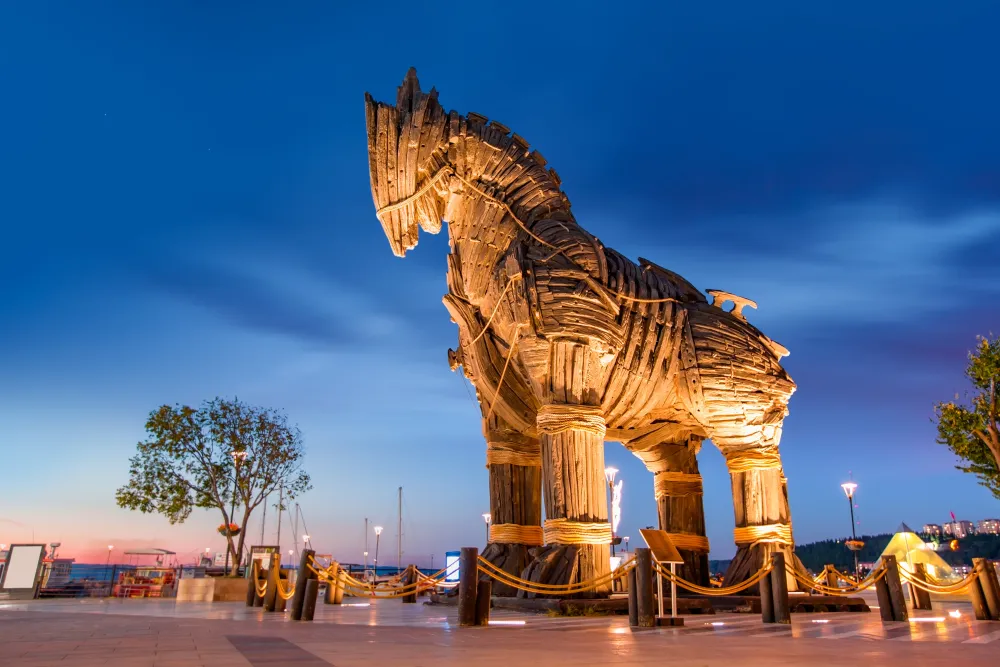
In 2004, the epic story returned to the big screen with the movie Troy,
starring Brad Pitt as Achilles. For the film, a monumental wooden horse was
built as part of the set design.
And here is the beautiful twist:
After filming ended, the production team donated the horse to the city of
Çanakkale.
Today, that very horse stands proudly along the waterfront promenade.
Visitors can see it up close — touch it, photograph it, stand beneath it —
bridging the gap between ancient myth and modern cinema.
It’s one of those rare moments where history, legend, and Hollywood meet in
the same frame.
Walking Through Layers of Civilization
What makes Troy extraordinary isn’t only the Trojan War.
It’s the layers.
Nine cities.
Nine different eras.
From the Early Bronze Age to the Roman period.
As you move through the site, you see how civilizations rose, flourished,
burned, and were rebuilt. The Romans even honored the legendary past by
constructing temples and theaters here, proudly connecting themselves to the
Trojan heritage.
Troy is not just a single moment in time.
It’s a timeline carved in stone.
The Feeling You Take With You
Troy isn’t the most monumental archaeological site in Turkey. It doesn’t
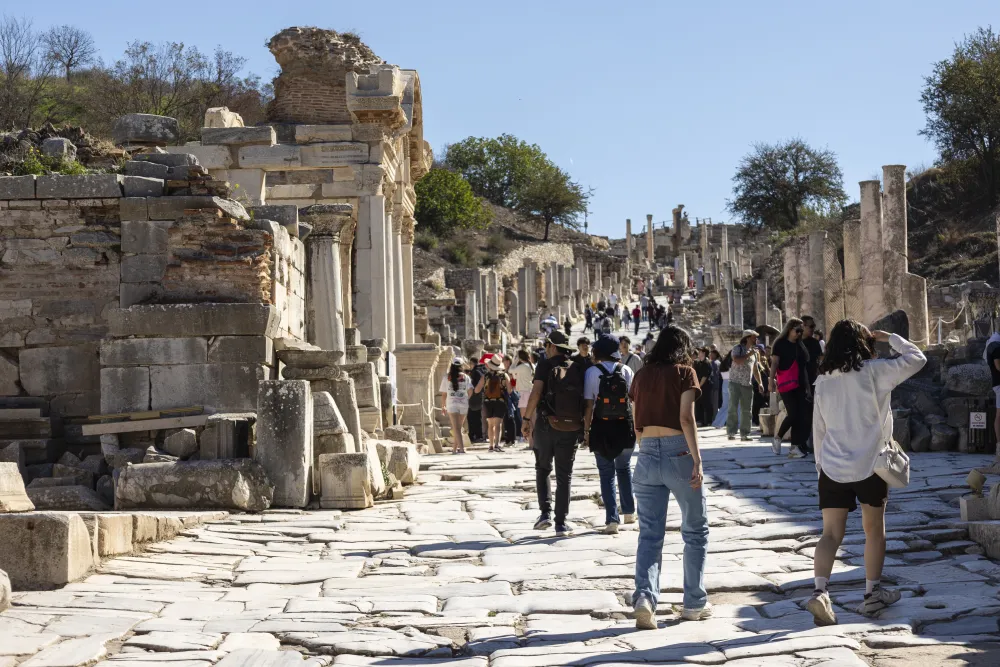
overwhelm you with towering columns like Ephesus or vast marble cities.
What it gives you is something different.
It gives you imagination.
As the sun begins to set over the plains, and the wind moves softly across
the landscape, you start to understand why this story survived for millennia.
You leave not with just photos —
But with a question:
How much of what we call myth is actually memory?
Visiting Troy Today
Troy is located near Çanakkale in northwestern Turkey and can easily be
combined with Gallipoli, the Dardanelles, or a longer journey through Western
Anatolia.
For travelers who love storytelling, archaeology, literature, and even
cinema — Troy offers a rare opportunity to experience all of them in one place.
And yes… you can stand in front of the famous wooden horse from the movie
before or after exploring the ancient ruins.
Two horses.
One from legend.
One from Hollywood.
Both telling the same timeless story.